

Key KPIs to maximize warehouse efficiency 2026
Talk aboutKey KPIs to maximize warehouse efficiencyIt is not a technical issue: it is aoperational survival issue. Because a warehouse can look orderly, have busy staff and processes in place… and stillbe losing money every dayif the correct thing is not measured.
TheKPIs, eitherkey performance indicators, arethe compass that guides each decision within the logistics operation. They tell youif your inventory is under control, if your processes flow as they shouldor yesyou are leaking invisible coststhat slow down your profitability. Without them, improvements and adjustments are based on intuition;With them, each step becomes a measurable and scalable strategy.
When you choose theappropriate indicators, candetect bottlenecks before they become crises, reduce errors, speed up deliveriesandincrease customer satisfaction. Instead, ignoring them means operating blindfolded.
In this guide you will discoverwhat KPIs really matter in a modern warehouse, how to calculate them step by stepandhow to use them to transform your logistics center into a precise, agile and profitable operation.
If your goal is to leave improvisation behind andstart making decisions based on real data, this is the starting point to achieve it.
1. Inventory Accuracy
Inventory accuracy is a critical KPI as it represents theaccuracywith which the inventory management systemreflects the actual quantity of products in the warehouseand in this way you will avoid losses, surpluses and delays in your orders. This control begins with a correct receipt of goods, ensuring that every item you enter is registered and verified from the beginning.
Implement processestraceability of a productFrom the moment it enters the warehouse, it guarantees full inventory control, reduces registration errors and improves visibility of the entire logistics chain.
Inventory accuracy is key to avoiding losses and delays. A strategic ally like afulfillment in Querétarocan help you have full control of your inventory and improve the accuracy of your records.
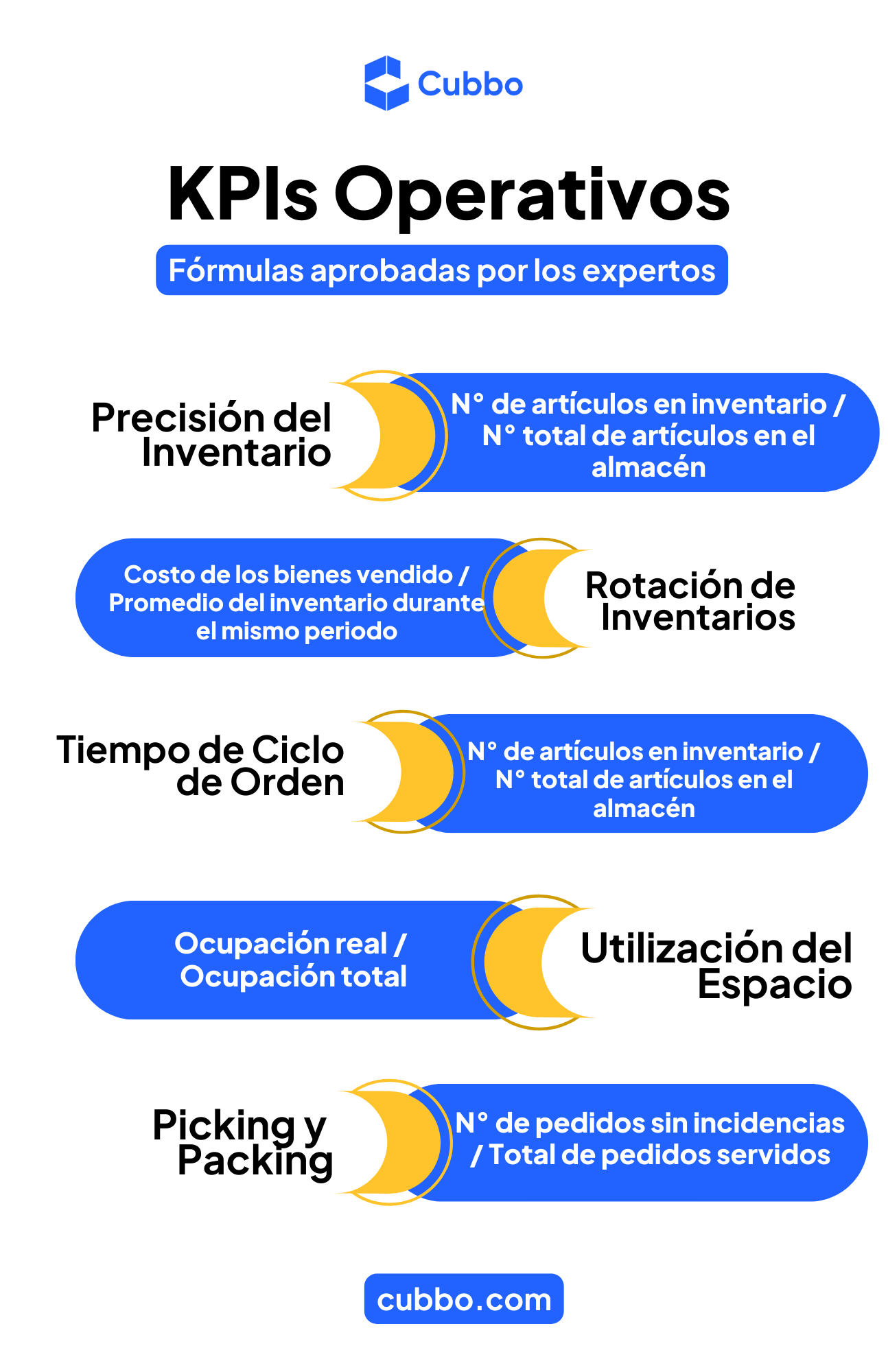
The formula to calculate Inventory Accuracy is 👉No. of items in inventory / Total no. of items in warehouse, known as IRA for its acronym in English.
2. Inventory Rotation
Inventory rotationmeasures how many times inventory is renewedin a specific period, usually annually. It is calculateddividing the cost of goods sold by the average inventory during the same period.
⚡ #CubboHack If you have a high turnover as a result, it means that you have effective inventory management and a quick response to market demand
3. Order Cycle Time
This KPI measures thetime that elapses from when an order is placed until it is delivered to the customer.An efficient order cycle time is crucial to customer satisfaction and can make a difference in customer retention.
Implement ashipping platform in MexicoAutomating order management can help you reduce this cycle and maintain a seamless delivery experience.
Optimizing this metric requires correctly coordinating picking, packaging and delivery processes.last mileto meet committed delivery times.
The formula to calculate the cycle time is:
Percentage of orders served on time: No. of orders served on time / Total orders to be served
4. Use of Space
Evaluate howThey physically distribute the products in the warehouseand it is an important factor as it determines whether the space is being used to the maximum or if there are underutilized or congested areas.
In urban operations, rely on ashipping platform in Mexico Cityfacilitates space optimization and last mile coordination.
💡 #CubboTip Optimizing warehouse layout can reduce costs and improve efficiency
The formula to calculate how much space you use is 👉Occupancy percentage: Real occupancy / Total occupancy
5. Picking and Packing Accuracy
This KPI focuses on the accuracy of the product selection and packaging process for orders. This formula measures the proportion of orders that are processed correctly in relation to the total orders.
⚡ #CubboHack High precision in this process is essential to avoid returns and maintain customer satisfaction. Furthermore, a goodunboxingreinforces the positive perception of the correctly prepared order and improves the experience of the final consumer.
Thecustomer experienceIt does not end when the order is shipped; Every detail in the preparation process influences how they perceive the quality and reliability of the brand, so measuring this KPI helps reinforce loyalty and repurchase.
Percentage of correct orders: Number of orders without incidents / Total orders served
💡 We recommend this articlePicking and Packingto reduce errors during this process
6. Cost per Order Processed
This indicator evaluateshow much does it cost to process each orderand includes costs such as labor, packaging, shipping, and warehouse overhead.
⚡ #CubboHack If you reduce this cost without sacrificing the quality of the service, you can significantly increase the profitability of your e-Commerce. An effective alternative isoutsourcing of logistics services, which allows you to optimize resources and focus on the growth of your business without assuming high fixed costs.
By leaning on alogistics company in Mexico, you can scale your operation without losing control or visibility of your key indicators.
7. Return Rate
The return rate indicates the percentage of products that are returned in relation to the total products sold.
💡 #CubboTip A high rate may indicate problems with inventory accuracy, packaging quality, or defective product management.
It can also directly impact your margins; Learn how to keep them healthy with this guide on how to calculate the selling price of a product.
How to build a KPI system that transforms your warehouse into a predictable and profitable operation
The true role of KPIs: not measuring, but governing the operation
Many businesses believe thatWarehouse KPIsThey only serve to “have numbers.” In reality, their function is much more strategic: they allowcontrol, anticipate, correct and escalateyour operation.
A warehouse that does not measure is a warehouse that:
- Does not identify money leaks,
- Reacts late to problems
- It cannot grow in an orderly manner,
- And make decisions based on intuition, not data.
Implementing KPIs turns your warehouse into aliving system, capable of showing where the flow slows down, where the error is concentrated and which processes need immediate redesign.
KPIs as a logistics flow map: identifying invisible bottlenecks
Each operation has points where efficiency is lost:
- Slow reception
- Saturated picking
- Inconsistent packaging
- Poor use of space
- Unbalanced Stocks
A well-designed set of KPIs allows you to seeat what stage is the flow stopping.
For example:
- Alow rotationidentifies products that tie up capital.
- Alow picking precisionpoints out human failures or poor layout design.
- Ahigh order cyclereveals problems with task assignment or packaging.
Each indicator has a function:reveal a blind spotso you can correct it.
From isolated indicator to integrated system: the most common mistake
Many warehouses measure “loose” KPIs. That generates wrong conclusions.
Classic example:
- If youinventory turnover is low, you may think you need more sales.
- But if you alsoinventory accuracy is poor, you will find that the turnover is not low: onlyyou don't know what you really have.
An integrated system connects KPIs to each other for deeper diagnostics.
So, you can:
- Detect systemic problems.
- Prevent mistakes before they become costly.
- Put together apredictive operation model.
How to define KPIs that do drive decision making
For a KPI to be useful it must meet 5 criteria:
- Clear→ is understood without complex explanations.
- Measurable→ It is calculated with real data, not interpreted.
- Actionable→ tells you what to do, not just what happened.
- Comparative→ allows you to measure progress vs. goals.
- Relevant→ impacts customer satisfaction and profitability.
KPIs such as inventory accuracy, returns rate or cost per orderThey are not operational metrics., butstrategic inputsthat affect sales, repurchases and reputation.
The importance of a KPI-oriented layout
Your warehouse must be designed to favor the indicators you want to improve.
For example:
- If you want to improvepicking times, place top-selling products closer.
- If you want to improverotation, use differentiated zones for A-B-C.
- If you want to improveprecision, designs one-way routes and clear verification stations.
A good warehouse design should also consider thecustomer service, since operational efficiency is directly reflected in the speed and precision with which orders, incidents and returns are responded to.
The physical layout of the warehouse is a critical factor in the evolution of KPIs.
Technological integration: the basis for measuring without errors
A common mistake is trying to measure KPIs with spreadsheets. This generates:
- Data lag,
- Duplicate records,
- incorrect readings,
- Decisions based on incomplete information.
A WMS or a modelprofessional fulfillmentguarantees:
- Inventory in real time,
- Digitized reception,
- guided picking,
- Traceability by SKU,
- Instant evidence of every action.
Technology is the “invisible muscle” that supports your KPIs.
A3PL in MexicoasCubbo, with control panel and automatic records, makes measuring automatic and not an additional burden.
How to turn your warehouse KPIs into a strategy for continuous improvement and sustainable profitability
Measuring without acting does not generate change.
TheWarehouse KPIsThey only make sense when translated intoconcrete actions that improve processes, reduce costs and increase customer satisfaction.
In this section you will discover how to go from having isolated indicators to building aoperational intelligence system, where each metric connects with the others and allows youanticipate, correct and escalateprecisely.
Because an efficient warehouse is not the one that makes the least errors, but the one thatdetect and correct before these errors are repeated.
KPIs and operational mentality: measuring is not auditing, it is evolving
In many companies, measurement is associated with “control” or “performance evaluation.” However, in modern logistics,measuring is learning.
Each KPI is a signal that helps you understand the real behavior of your operation, beyond intuition or the appearance of order.
Adopt acontinuous improvement mentality based on KPIsinvolves three key changes:
- Go from data to diagnosis.It is not enough to know that picking failed by 3%; you have to understand why.
- Go from diagnosis to action.Each indicator must have an assigned operational response.
- Move from action to prediction.Once patterns are identified, the data makes it possible to anticipate error or saturation peaks before they occur.
In other words, KPIs not only show what is happening:They teach you how to evolve.
How to build an effective KPI dashboard
Aoperational dashboardit doesn't need 30 metrics to be useful; you need the right ones.
The most profitable warehouses focus on a narrow set ofactionable indicators, distributed in four main areas:
- Inventory:precision, rotation, break level and frozen value.
- Productivity:orders processed per hour, picking and packing accuracy.
- Service:order cycle time, on-time deliveries and returns rate.
- Costs:cost per order, storage cost and space efficiency.
Each group must havea quantifiable goal and a direct person responsible.
That way, tracking becomes part of the daily flow, not an isolated month-end task.
💡 #CubboTip:automate your dashboard. A system like that ofCubbo, with full traceability and real-time data, eliminates the risk of manual errors and allows youmake operational decisions every day, not every quarter.
Connecting KPIs with your business objectives
One of the most common mistakes is measuring indicators thathave no direct impact on profitability.
Each KPI must answer a strategic question:
- Does it increase customer satisfaction?
- Does it reduce operating costs?
- Does delivery speed improve?
- Does it strengthen the reputation of the brand?
If a KPI doesn't influence any of these areas, it probably doesn't deserve to be on your main dashboard.
For example:
- Improve theinventory accuracyNot only does it avoid returns, it also increases customer confidence and reduces capital immobilization.
- Optimize thecycle timeIt not only speeds up deliveries, but also frees up operating capacity during peak demand.
- Reduce thecost per orderdirectly impacts the gross margin of ecommerce.
The correct KPIs are those thatThey unite operational efficiency with business profitability.
Real-time measurement value
In logistics,every hour counts.
Therefore, depending on weekly or monthly reports is no longer enough.
Modern warehouses use technology toview your indicators in real time, allowing them to react before a problem turns into a loss.
With an automated system you can:
- Detect an increase in returns and review the cause on the same day.
- Identify delays in picking before they affect delivery times.
- Redirect resources or personnel according to the current operational flow.
Thatdecision agilityThis is what differentiates a reactive operation from a proactive one.
Cubbo, for example, allows its customersmonitor inventory, orders and fulfillment metrics minute by minute, guaranteeing precision and total control without the need for spreadsheets.
How to use KPIs to anticipate demand
One of the biggest benefits of having reliable historical data is theability to predict future behavior.
If your indicators show that certain products have higher turnover in certain months, you cananticipate demand peaksadjusting inventory, personnel and packaging.
This provision prevents:
- Overstock, which immobilizes capital and space.
- Inventory breaks, which generate sales losses.
- Extra transportation costs, for emergencies or accelerated deliveries.
When KPIs becomepredictive models, your warehouse stops “reacting to the market” and startsget ahead of him.
KPIs and team culture: how to involve people
Measurement is important, butmake the team live the indicatorsIt is what transforms the results.
The best warehouses are not managed from offices: they are managed from the operating floor, with the team committed to improving each number.
Some effective practices:
- Communicate results weekly in a visual and accessible way.
- Recognize teams that improve key metrics (for example, accuracy or speed).
- Define shared goals, not just individual ones, to strengthen collaboration.
- Connect each KPI with its direct impact (“if we improve picking, we reduce returns and that keeps customers happy”).
when everyone understandswhy KPIs matter, measuring stops being a requirement and becomes acause of collective pride.
Technology and automation: the basis for reliable KPIs
You can't improve what you can't measure, and you can't measure well without reliable technology.
Spreadsheets or manual records generateerrors, delays and inconsistent data.
A system ofWarehouse Management System (WMS)or a 3PL operator likeCubboguarantees:
- Automatic reading by barcode or QR.
- Digital receipt of goods.
- Technology assisted picking.
- Control by SKU in real time.
- Automated reports by shift or day.
These systems eliminate friction between operation and measurement, making KPIsnatural part of the process, not an additional burden.
Furthermore, they allowcompare performance between warehouses or shifts, an essential step to scaling with consistency.
From efficiency to profitability: warehouse financial KPIs
Beyond operational indicators, there are financial KPIs that help you understandthe real cost of your logistics operation.
Some of the most important are:
- Total logistics cost on sales.
- Cost per square meter used.
- Average value of immobilized inventory.
- Savings generated by automation.
Measuring this data allows youcalculate return on investment (ROI)of your warehouse and justify technological improvements or expansions.
An example: if your cost per order processed decreases by 10% after optimizing picking, you can project a direct increase in operating margin.
That is where KPIs stop being “reports” and becomefinancial decisions with tangible impact.
How to maintain constant improvement
Measurement does not end when a goal is achieved. In logistics,Each improvement opens the door to new optimization.
Implement periodic review cycles:
- Analyze KPIs monthly.
- Detect deviations.
- Redesign processes or layouts.
- Train the team.
- Repeat the cycle.
This dynamic, inspired by the Kaizen model, turns your warehouse into acontinuously learning organization.
Over time, you will see how small accumulated improvements translate intohigher productivity, lower costs and more satisfied customers.
To maximize the efficiency of your warehouse, it is essential to measure and optimize these KPIs on a regular basis. With this information you will be able to identify areas for improvement and make informed decisions. By doing so, you will not only improve warehouse operations, but you will also increase customer satisfaction and the profitability of your business. Remember that KPIs are powerful tools, but their success lies in how they are applied and interpreted in the context of your operation.
Finally, remember that operational efficiency is also related to risk management. Learn how to protect your income and avoid losses due to claims in this article on ecommerce fraud and chargeback, essential reading for any modern logistics operator.
InCubboWe can support you in meeting your operational KPIs, visit our site so you can be more efficient throughout the Fulfillment process