

E-commerce by the Numbers: Key Figures 2020–2021
Estimated reading time: 6 Min
E-commerce has experienced exponential growth in recent years. We are witnesses to the evolution of a phenomenon that will not stop. How did e-commerce perform during 2021? Let's look at some data and significant figures from the latest year.
Below, we will analyze four fundamental aspects of e-commerce measurement, which give us a quite interesting overview of its behavior in Latin America:
* Internet penetration
* Increase in the number of online shoppers
* E-commerce share in retail
* Online sales
Significant e-commerce figures: Internet penetration
Studies by Hootsuite show that the number of internet users continues to increase every day, expected to reach 5 billion in 2022—a figure that for 2021 was 4.95 billion people, representing 62.5% of the world's population.
Internet penetration by region
Greater internet connectivity also generates a greater number of online buying and selling operations, since there is not only access to online stores but also to new channels or modalities such as social media or live shopping, which has undoubtedly contributed to e-commerce growth in Latin America and the world. Let's see how our region compares to other territories with greater and lesser evolution in this field.
During 2020, according to ECLAC studies, Latin America reached 74% internet penetration—a figure that for North America was 88% and for Western Europe 92%. For 2021, Western Europe's penetration rose to 94%, while North America climbed to 92% and Latin America reached 75%.
The region with the highest internet penetration today is Northern Europe, at 98%, while the least connected are Central Africa and Eastern Africa at 24% and 26% respectively.
If we talk about China, the world's strongest e-commerce economy, according to the 48th Statistical Report on Internet Development in China, the penetration rate for June 2021 reached 71.6% in that territory—a figure that may seem low compared to North America or similar to that reported by Latin America. However, China's population exceeds 1.4 billion inhabitants in a single country—a figure that far exceeds the total population of the other two regions combined (LA: 660 million – NA: 330 million).


Significant e-commerce figures: Growth in shoppers
According to Statista studies, in recent years Latin America has experienced progressive growth in online shoppers, registering 267 million in 2020—a 55% growth for that year, a figure above the global average, which for the same period recorded 15-point growth.
According to the latest projection by Statista, based on growth levels, the number of online shoppers is expected to reach 351 million users in Latin America by 2024, estimating an approximate average growth of 21 million per year. This may indicate that in 2021 the number of shoppers in Latin America reached 288 million.

Significant e-commerce figures: Share of retail sales
Year after year, e-commerce has been gaining ground in retail sales, increasing its penetration in this market. Worldwide, 19.6% of retail sales in 2021 came from the digital channel—a figure that for 2020 reached 18% (eMarketer).
In Latin America, online sales represented 5.6% of total retail sales in 2020—a figure that for 2021 is estimated to have reached 6.2%. For Mexico, during 2021 online sales of $401.3 billion pesos were recorded, equivalent to 27% growth compared to 2020, representing 11.3% of total retail sales in the country—2.3 points more than in 2020, when e-commerce penetration in retail was 9%, according to AMVO figures.
Read also: E-commerce Growing by Leaps and Bounds
For Colombia, according to the Colombian Chamber of E-commerce, during the first 8 months of 2021, online sales represented 2.7% of total retail sales in the country—a figure that for 2020 stood at 2%, registering 0.7% growth.
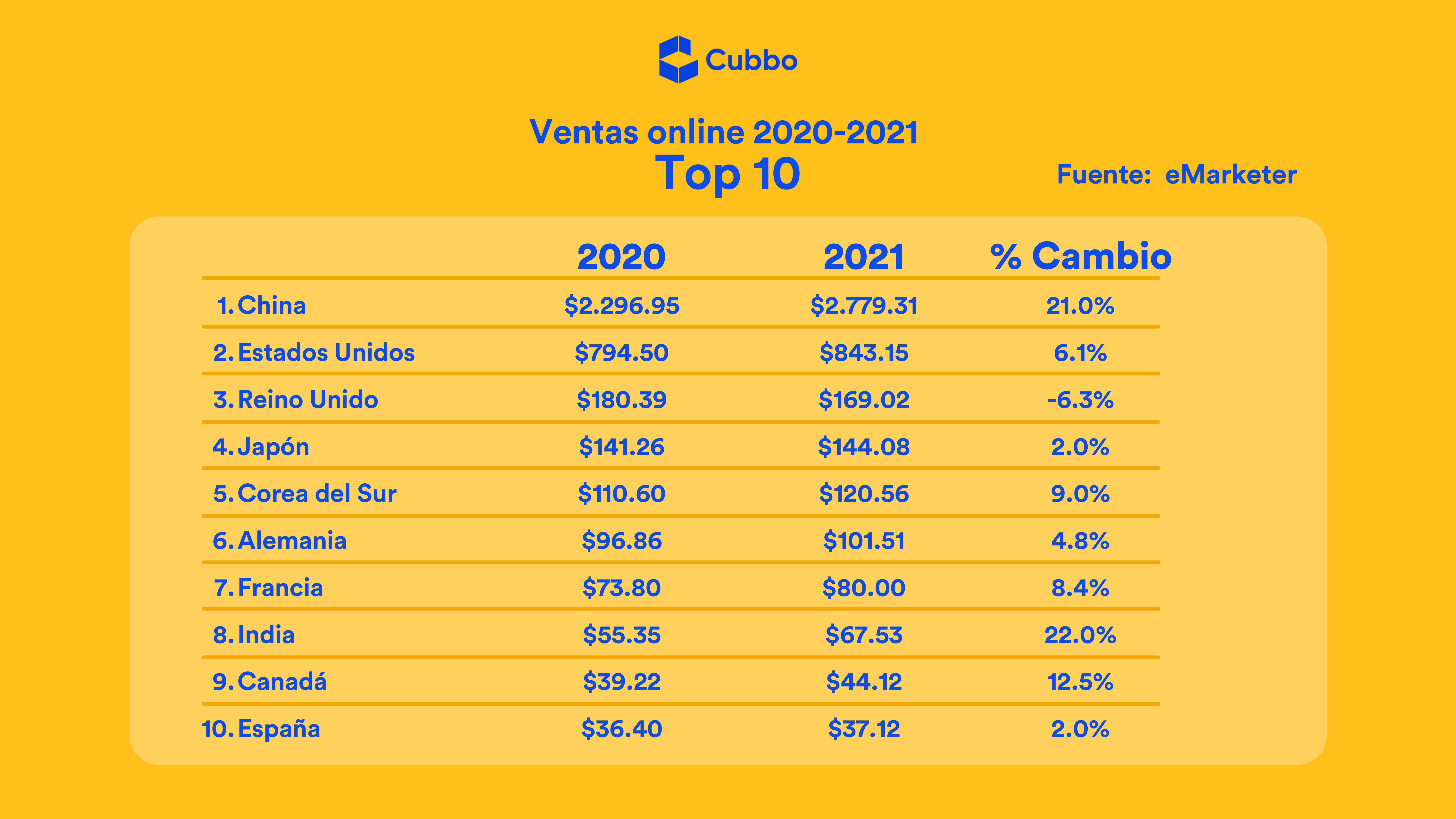
If we turn to China, according to eMarketer, the Asian country recorded sales of 2.297 trillion in 2020, representing 44.8% of its total retail sales. For 2021, its sales increased to 2.779 trillion, meaning 52.1% e-commerce penetration in retail.
China's e-commerce figures are so impressive that it is calculated that 56.8% of e-commerce sales worldwide occur in this territory.
.jpeg)

Significant e-commerce figures: Online sales
Global e-commerce grew 16.8% in revenue during 2021, representing approximately 4.9 trillion dollars for the year—a figure that for 2020 registered a total of 4.2 trillion dollars worldwide.

Within this landscape, during 2021 Asia and North America continued leading as the regions with the best e-commerce figures in the world. Their influence is such that Asia-Pacific registered approximately 60% of global online sales, while North America with USD 843 billion ranked second with 20%, followed by Western Europe with 12%. The remaining 8% is distributed among Eastern Europe (fourth place), Latin America (fifth place) with sales close to USD 90 billion, and the African region (sixth place), according to Statista figures.
The following chart shows the top 10 countries in online sales during 2020 and 2021 (figures in billions).
Other interesting e-commerce data
* "In 2021, Brazil and Mexico concentrated more than 70% of the e-commerce market in Latin America, followed by Colombia. Other countries in the region such as Chile, Argentina, and Peru are expected to experience rapid e-commerce growth in the coming years."
* In general projections, e-commerce in Latin America is expected to grow 31% per year through 2025 (NubeCommerce).
2021 was characterized by harmonizing Covid measures with the daily lives of millions of people. This phenomenon left us not only multiple life lessons, but also changes in shopping habits that will continue increasing the number of users who choose online stores as their first purchase option.
The digital channel will not stop its path toward growth. The challenge now is how different e-commerce players can meet the increasingly demanding needs of the end user, where differentiators, service, and delivery times are increasingly the battlefield where customers are won or lost.
Looking for a partner to boost your delivery process, fulfillment, and customer satisfaction? Don't hesitate to contact us—we are the best fulfillment center for e-commerce in Mexico and Colombia—just click here.
In markets like Mexico, logistics infrastructure has been key to sustaining digital channel growth. Having fulfillment partners in Mexico City allows e-commerce businesses to respond with fast, reliable deliveries, improving customer experience and increasing repeat purchases.
Information sources:
Eleconomista / Marketing4ecommerce / hootsuite / Blacksip / Content.blaksip
Statista / Statista / Statista / Bnamericas / d1ih8jugeo2m5m / valoraanalitik / Elfinanciero / Eluniversal / Statista / Marketing4ecommerce / Mintic / Statista / AgenciaBrasil / Statista / Telam / Tolltester / eMarketer / eMarketer / CCCE / Expansion / Americaretail
48th Statistical Report on Internet Development in China / Online sales study, the Mexican digital consumer AMVO 2022