

ABC of Home Delivery
Estimated reading time:13 min
The last mile as a critical point of the customer experience
In ecommerce, the experience does not end when the customer pays. In reality, that is where the most sensitive moment of the process begins: delivery. The last mile is the only point of physical contact between the brand and the buyer, and any failure in this section directly impacts the perception of the service.
Delays, lack of communication or failed deliveries are not interpreted as logistical errors, but as brand errors. Therefore, optimizing the last mile is not only an operational challenge, it is a strategic decision that defines the reputation of the ecommerce.
Why speed is no longer enough
For years, competing in deliveries meant being faster. Today, speed is just the starting point. The consumer expects fast deliveries, but also predictable, communicated and reliable.
Delivering on the promised deadline is more important than promising impossible deliveries. A ecommerce that promises 24 hours and delivers in 48 without warning generates more frustration than one that promises 72 hours and delivers without errors. The key is to align promise, operation and communication.
Did you know? Between 85 and 90% of the logistics cost of aecommerce, it's the last mile.
If we have learned anything during the last few months, it is that the world can change from one moment to the next, and that those who are not prepared or willing to reinvent themselves will not be able to overcome the change.
A few decades ago, when a company entered the S&P 500 index, it had a life expectancy of more than 60 years, that is, it was here to stay. Today, 52% of these companies have disappeared, since the projection of permanence in this index was reduced to 17 years. Why? Because companies do not know how to adapt and although they become great representatives in their sector, due to eventualities external to the company, they are unable to face the changes, and this ends up “killing” them.
Many of the most important decisions of a company are not made by the General Director, nor by the Innovation or Commercial areas; They are taken by external factors such asCOVID 19, a phenomenon that found many companies ill-prepared, forced their closure or forced them to adapt to stay afloat in the market.
Transformations will always be necessary, we live in a world that is constantly changing, where competition In the logistics field it is stronger every day and has been evolving over time, for example, imagine Walmart 5 or 10 years ago, when it competed against the same format, basically, self-service. Today, it faces international companies, such as Chinese ones, because in the current market, you no longer have to be physically in the same location as the consumer to be able to sell and deliver the product.
Big growth, big challenges
In the United States, during 2019, theecommerceIt represented sales of 12,000 million pesos. How much is Mexico compared to this figure?: one 18th. Obviously there is a whole issue of population, economy, among other factors involved, but it gives us an idea of how far we still have to go. Even if we added the income fromecommerce from Latin American countries such as Mexico, Peru, Chile and Ecuador, even so, we would still have one twelfth left to grow compared to the North American giant.

Let's now analyze another aspect, how was the growth of online sales during the first weeks of the Coronavirus? In 10 years, the United States grew 11 percentage points in penetration against retail, the same 11 points that grew in the first 8 weeks of COVID. In Mexico, we had online sales of $316,000 million pesos during the pandemic, however, if this growth was incredible on a commercial level, in terms of operation, it was a headache.
We couldn't cope! The market exploded and we were not prepared, the supply chain collapsed, affecting not only theecommercebut to the consumer due to delivery times, shortages, etc., We were not ready! We did not have an efficient operational muscle to cope with this monumental growth.
How did 2020 close?
During this period, with respect to theecommerce, Mexico grew 81% compared to 2019; In Latin America, growth was 66%. Our country has been at the forefront of evolution in this field for 3 consecutive years, that is, we are in the best place in Latin America for the adoption of the ecommerce, which is really positive for companies that want to expand their sales channels in this region.
Regarding the percentage of sales represented by theecommerceIn total retail sales, we are currently at 9%. What does this figure mean? How far away are we from more established countries? China, for example, is reaching 50% of sales per ecommercecompared to the total retail, which is surprising. We still need to grow 500% to reach this economy, a great challenge, right?
To achieve the previous objective, we need to be prepared in 4 main aspects:
- Consumer confidence:let's remember that We come from a culture of fraud, where the fear of being a victim of this crime inhibits online purchasing decisions, ourecommerce must provide the buyer with the necessary confidence to make their purchase. Buy with peace of mind, offering you the guarantees so that you feel safe throughout the entire process.
- Lack of logistics infrastructure: an aspect that last mile companies that have entered the country have been addressing, with which we are strengthening the delivery infrastructure.
- Lack of banking: only 30% of the Mexican population is banked, in order to attack the remaining 70%, payments on delivery must be implemented, or alternative payments to sell forecommerceto the entire population.
- Lack of regulations:Mexican electronic commerce is not yet well regulated, as is the case in other countries.
Why is logistics important?
What are the challenges in Mexico to increase the percentage of online sales and reach 500%? And why is logistics key to this goal? Primero, start by asking yourself: Why do people buy online? The answer is simple, because you receive your purchases at home, save time, buy faster, find things that are not at the point of sale or products that are not sold in Mexico and access better promotions on this channel.
The above are the purchase motivators, but as in any story, there are also those aspects that make the process doubtful, for example, consumers fear making a mistake during the purchase and not being able to change the product or they do not know how to pay in cash. If you realize, of the previous aspects, both motivating and denial, most are related to logistics or find a solution from it.
Now, let's consider other important aspects, tips that from theecommerce should not be ignored…
- The consumer's preferred delivery location is home or work.
- The benefit that interests the buyer the most is free shipping.
- What the consumer expects most is that the product arrives in perfect condition, having communication throughout the process; compliance on the delivery date, and guarantees against damage that the package may generate to the order.
- A quick and easy exchange and return process is also valued by the buyer.
Again, if you realize, there is only one constant in the previous points: the high dependence on the logistics area to offer a very good purchasing experience, provide security to the customer and resolve their needs. If you have inefficient logistics or a weak logistics muscle, you will not achieve these objectives.
Retail vs ecommerce operational process
Whatever you sell, you have two aspects from logistics, one is called Procure to Stock, what you do from when you buy the product until you store it, The other is Order To Delivery, which occurs from the moment a sale is received until the order is delivered to the customer. Both phases occur during the operational process, both retail andecommerceHowever, its execution in each case is very different.
The worst thing you can do is dabble inecommerceWith the same logistical muscle that you serve retail, it is like wanting to swim with your legs, you are going to move, but not as fast as with your arms, so they are two totally different muscles. Let's make the comparison:
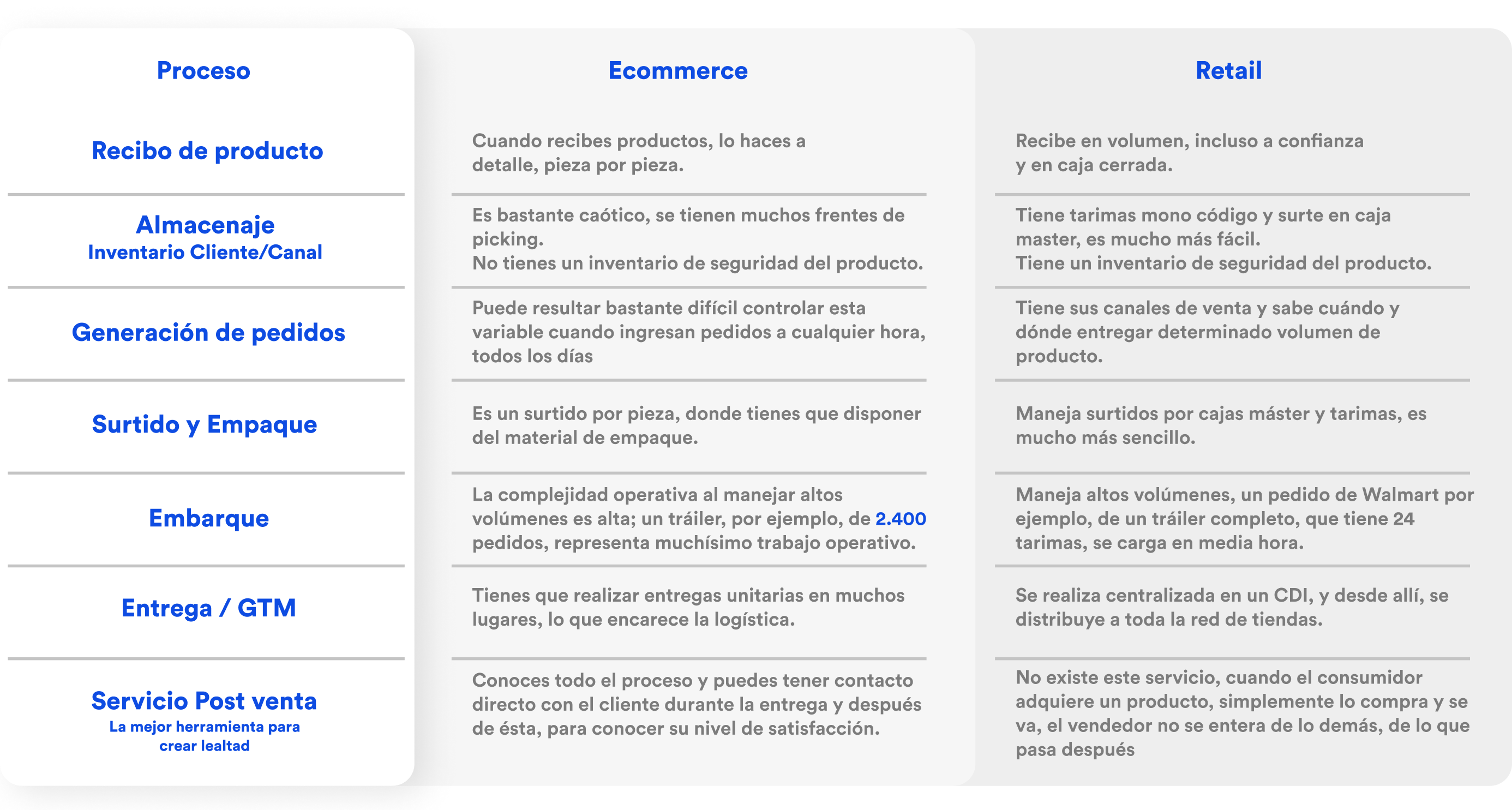
What is the online consumer looking for? What can we give you?
Achieving customer satisfaction from the operation is not that complicated, you only need 3 things:
1. Visibility, transparency and communication.When the customer buys, they want to know perfectly where their order is, at all times, and if any eventuality arises, they want to be the first to know. Be transparent by providing the status of the order: on the way, in transit, with the delivery person, and, above all, when you cannot meet the delivery date, the product, or the quantity, be honest with your customer and inform them of the situation. If you can't deliver the next day, don't offer it.
2. Tranquility and guarantee.If any eventuality occurs, let theecommerce respond. Regardless of the issue with the parcels, you must respond to the end customer for unforeseen events, he bought from you, not from the transportation provider.
3. An experience.In itecommercethere is no in-person shopping experience, you cannot go to a store, talk to a person or touch the product, theecommerceThey must devise strategies like the previous ones, to provide a satisfactory shopping experience in the digital world.
Cost of serving in ecommerce vs retail
At a logistical level, you should always be very clear about what the cost of serving is? That is, the costs associated with fulfilling the customer's delivery promise, in how long, the quantity you want to deliver and the quality of the product. Segmenting the cost by sales channel is the most optimal, at a commercial level, you will know how much it costs you and how much the profit will be.ecommerce, compared to retail.
If you are very clear about these numbers, you will be able to understand the associated costs of delivering to each client and even provide discounts, due to the logistical savings that you can generate.
Let's look at a simple cost comparison:
- When you receive a product inecommerce, it is very expensive, since you do it by piece instead of a box, at the storage level, it is also more expensive, there are many picking and shelving fronts, unlike retail, where you store by complete pallet.
- Regarding the generation of orders, in theecommerceIt is very cheap to do it, it is all automatic through platforms like Shopify, for example, you do not need a person registering orders, while in retail, it is more expensive, since you require sales personnel who are verifying the orders, which increases the cost.
- At the assortment and packaging level, in theecommerceIt is more expensive, you supply per piece and require packaging material, which generates more expenses; In retail, you supply by box, by pallet and it is very economical.
- At the delivery level, between 85 and 90% of the logistics cost of the ecommerce, is the last mile, which is very high, compared to retail, where a local trailer for Mexico City, for example, can cost $5,000 pesos, while delivering by ecommerce2,500 packages, which is approximately the proportion of a trailer, with parcels, will cost you 50 times more, they are two totally different operations.
If you want to know in detail the differences in costs by sales channel, we invite you to visit our articleFrom Zero to ecommerce, where will you know, what it costs to carry out the operation on your own.com (Direct To Consumer) and how much it costs you to do it through Marketplace channels such as Amazon or Mercado Libre.
To make your cost management from logistics more efficient, you must start by understanding the strengths and weaknesses of your business, and implement strategies to reach a low cost per unit, increasing operating volume. Below is a practical example:
Within the Dermocosmetics industry, a small size cream costs $500 pesos plus $100 pesos for shipping, it is an economical value. If you ship two pieces, it is $1000 pesos for product and $100 for shipping, that is, very cheap. On the other hand, when you sell a grocery product, shipping can cost you almost the same or more than the order; If you send 1 kg of rice to Tijuana or an iPhone, it has exactly the same logistical cost, but at the percentage level of price and profit, the difference is enormous.
Despite the above, you cannot be inefficient in your logistics, devise strategies to optimize in this field, for example, you can open delivery frequencies by location and focus on the delegations with the greatest population and demand. When you sell a very cheap product, you can also penetrate the market through ecommerce.
Let's talk about trends
7 years ago, people were looking for mass production at a competitive cost, that was the added value, for example, having a factory that produced jeans and being able to distribute them to many places. 60 years later, people began to pay attention to quality, it was no longer just a matter of mass production but production under certain standards. 20 years later, they were not only looking for quality jeans, the brand's branding began to play an important role. Shortly after, the topic of service and the purchasing experience was incorporated.
Currently, the trend, what the consumer wants as added value, is a matter of collaboration to generate a better experience. Studies affirm that for every peso you invest in collaborating with your client (commercial strategy, customer outreach and knowledge, CRM), you receive $5.6 pesos, which is quite profitable.
In terms of trends at the channel level, there are the Delivery Apps for theecommerce, while retailers are transforming to eTail, to their own .com, to have an influx of people, both physically and digitally; Taking advantage of this, they build Marketplaces so that sellers can offer their products in these showcases, sell them and deliver them to the end customer.
On the other hand, and in terms of operating models, the trend is called omnichannel; in Last Mile, how you coordinate delivery, how you charge in COD, how you manage reverse logistics, etc. In the future, there will be lockers to deliver there and for the consumer to go when they want to pick up their product.
We also found the Drop Shipping trend: collaboration of deliveries with your suppliers. This is what Marketplaces do, where they sell the product and then tell you which buyer to deliver it to.
Finally, at an operational level, there is the Micro trendFulfillment, which consists of having warehouses very close to the consumer, where orders arrive, are filled, packed and shipped. They are located at small distances so you can make deliveries in less than an hour.
Allies or strategic partners
Who do you have to work with, who are your allies or strategic partners to have good management of theecommerce? This topic contemplates two important aspects: learning to do things well and the cost, how cheap it is to do them.
When you carry out the logistics process internally, unless you are an expert, you must go through a learning curve that will involve errors and investment. When you outsource to a specialist, from day 1 you will be doing things right.
At the cost level, when you do everything internally, you have various fixed expenses, which, as there are few orders (as happens at the beginning of aecommerce), make your unit cost very high. Later, as you grow and increase sales volume, you must change warehouses, because you will outgrow them. Here, you enter the same circle again, where the unit value becomes expensive again. On the other hand, when you outsource, they normally charge you a cheaper variable cost than doing it internally.
Based on the above, there are 3 strategic alliances or suppliers that you can have:
1. Operativo.If you are a retail company you should look for a 3PL supplier, if you have aecommerce, look for a Fulfillment Center; With both, you will have an advantage in terms of learning and a competitive advantage in terms of cost, due to the concept of economy of scale. For operations in the Bajío region, fulfillment in Querétaro helps accelerate deliveries and optimize costs.
2. Last mile.Unless you are a company like Bimbo, which has nationwide distribution, even in the most remote places, you should partner with last-mile couriers to make deliveries, both in retail and inecommerce, in the first, they are transport providers of one and a half, three and a half, trailers, etc., while, for theecommerce, are parcel companies that help you reach different places, without you having to operate directly in those places.
3. Payment gateways.They are very important in theecommerce; In some cases, the customer does not have confidence to buy and in others, there are people who buy with their credit card, the product arrives and they call the bank to inform them that they did not purchase it, then, since online commerce is currently not well regulated, the bank returns the money to the customer and takes it away from the customer.ecommerce; you lose the product, the payment, the freight and the bank commission, ultimately, it is the worst deal in history.
So that this does not happen or is minimized as much as possible, you must make sure that you hire a very good payment gateway that provides you guarantees in these cases, Mercado Pago and Paypal are two good options.
Mide and controla
Everything that is not measured is not controlled, and everything that is not controlled is not improved. It is important to measure your results, no matter the size of the company. At a logistical level, you can measure the following indicators per process:
1.Procure to Stock. It is made up of 3 indicators:
- IRA: measures inventory reliability, if your system says you have 100 pieces, you go and count them, how many do you have? The objective is to have an assertiveness greater than 99.5% in this indicator.
- Dock To Stock: How long does it take, from the moment the product arrives at the door of your warehouse until you organize it to start selling?
- Compliance with the supplier's program: develop all activities that help you make deliveries faster.
2. Order To Delivery. From when the order is entered until you deliver it, the following are logistical indicators, although they have objectives ofecommerce:
- Fill Rate: percentage of customer demand that is satisfied with existing inventory. In companies like Walmart, this indicator is at 97%, in ecommerce, it should not be below 99.9%.
- On Time Order To Ship: The time that passes from when the order is placed until you send it, ideally it should be less than 24 hours.
- Picking Acuracy: precision in order preparation, you should never misdeliver an order to the customer.
- Transit Time: You have to have it super measured so that you can offer your buyer real delivery times.
- On Time Delivery: make 99.9% of your deliveries within the stipulated time.
- Backorders: backorders that cannot be delivered at the current time, due to lack of inventory, must be below 0.01%.
- Cost of serving: we talked about it before, you must measure it with a magnifying glass.
Indicators at the Customer Service and reverse logistics level
Although at the level of reverse logistics, the return percentages in Mexico are still very small (between 1 and 3%), with the increase in regulations for online purchases, their level will increase considerably, especially in the clothing and footwear sector, you must measure this indicator and be prepared to face the process. If, for example, you have a lot of exchanges and returns, you may not have a good size guide.
Regarding Customer Service, you must evaluate the percentage of tickets and analyze how you can improve it. If you sell 100 orders a month and have 90 tickets, something in the process is really wrong. You must measure First Time Contact to determine how much time, from when you receive a ticket, you have the first response; This depends a lot on the error or problem that the buyer has, it is not the same as asking you: “Where is my guide?” or “What is the status of my order?” To be told: “My order did not arrive.”
Remember: execute, measure and improve. Furthermore, take advantage of the advantages ofecommercesuch as the agility to sell and contact with the end consumer to request their feedback and develop greater closeness, from there, you will be able to build better purchasing experiences every day.
Are you looking for an ally to help you improve your delivery process, enhance your compliance and the satisfaction of your customers? Do not hesitate to contact us, we are the bestfulfillmentcenter for ecommerce in Mexico and Colombia,you just have to clickhere.