

Marketplaces in Latin America: The Kings of Online Sales
Estimated reading time: 6 Min
With global sales reaching $4.28 trillion in 2020, shopping online is one of the most popular consumer activities in the world. Without a doubt, this trend will endure: e-commerce will continue to expand, and its digital sales channels will gain relevance every day.
Where the action happens
As we discussed in our previous article, online sales have two main channels. One is Direct To Consumer (DTC)—owned e-commerce stores where companies choose a platform such as Shopify, WooCommerce, Magento, or others to build their online store under their brand domain and offer products or services directly to the consumer, whose satisfaction and closeness become the business's primary goal.
Direct To Consumer has gained relevance over recent years, especially during the pandemic. Its presence has been strengthening in Latin America and worldwide, and more companies every day are considering moving their offering to the digital environment. Later, when there is greater development, it will be interesting to find out its penetration percentage by country—from Cubbo we will be sharing this information with you.
The other channel is the Marketplace, such as Mercado Libre, Amazon, Walmart, Liverpool, Claro Shop, and many others, which act as intermediaries between the customer and the seller. They are generally well-known brands that charge the supplier a commission per sale in return for allowing them to appear on their platform or virtual storefront.
And it is precisely Marketplaces that we will talk about in this article. These e-commerce giants have taken over the online sales market, generate millions of dollars in annual revenue, and have become both an ally and a necessity for product commercialization—especially for businesses that do not yet have their own online store or need to build brand awareness.
The Marketplace in Latin America keeps growing
COVID-19 not only drove significant growth in DTC, leading millions of companies worldwide to pivot toward this sales channel—as expected, Marketplace results also reached high growth rates. During 2020, these channels increased their sales levels as we will see in the following chart by region, where the greatest evolution occurred in LATAM with 36.7%, 10.3% more than territories such as Asia, home to e-commerce giants like China—a context that presents a quite favorable scenario for these sales spaces.

Marketplaces with the highest sales volume
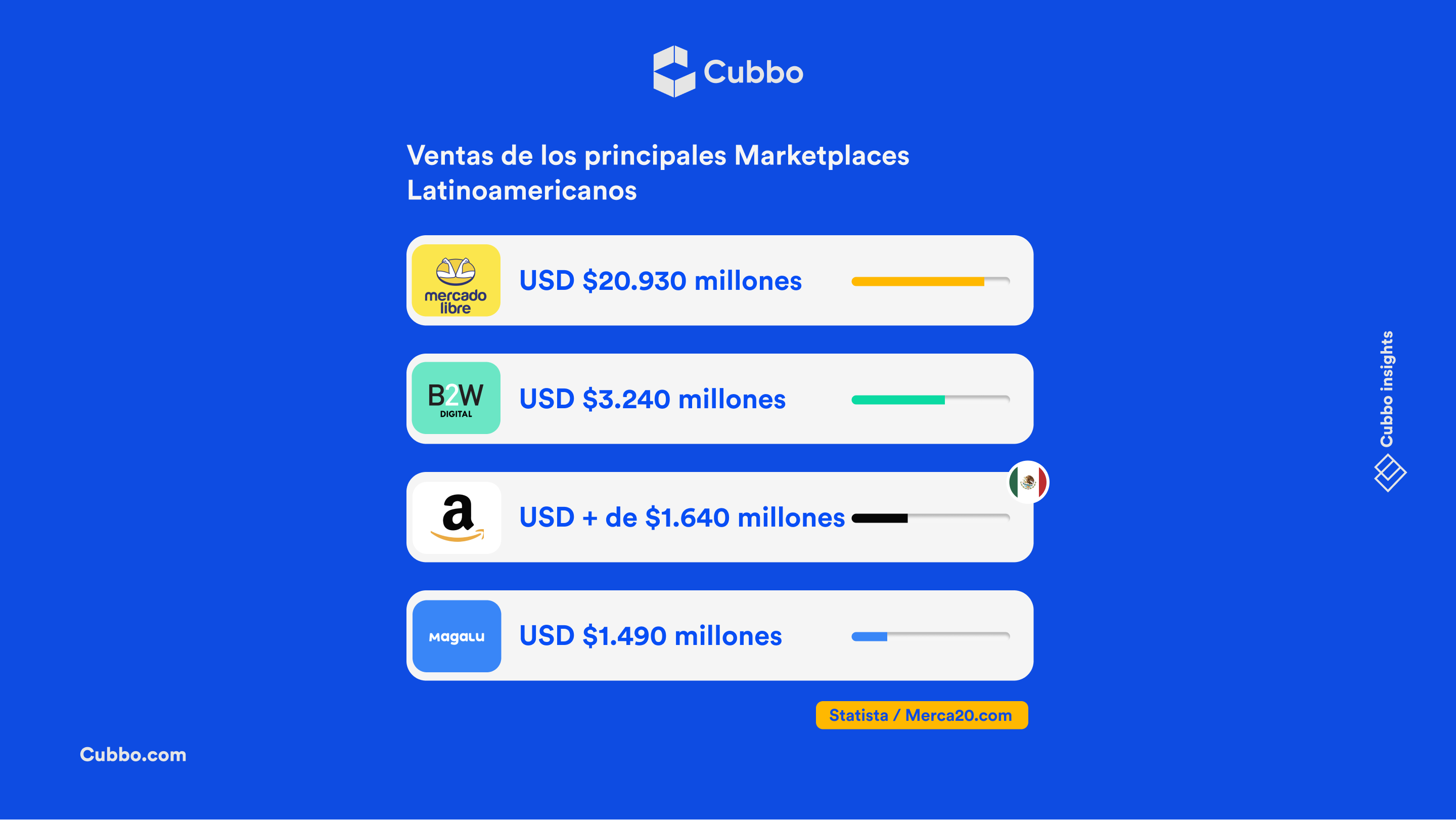
Four platforms share the market in Latin America. Among the Marketplaces with the highest number of sales in the region during 2020, we find the following:
Mercado Libre: the Argentine-born giant is among the fastest-growing online marketplaces worldwide. Its sales in LATAM during 2020 reached USD $20.93 billion, representing 24.6% of total Marketplace sales in the region. It also recorded nearly 668 million visits per month, while its total number of active users reached 132.5 million (approximately half of online consumers reported in Latin America for this period).
Among the three countries where it recorded the highest number of sales during 2020, we find Brazil, where it ranks as one of the most widely used mobile e-commerce apps, reporting sales of more than USD $2.2 billion; followed by Argentina, where it totaled USD $980 million, and Mexico with USD $575.2 million. In other territories such as Chile, Colombia, and Peru, Mercado Libre doubled its sales during the pandemic—results that demonstrate its important positioning in the region, where it surpasses global players such as Amazon.
B2W Digital: the Brazilian e-commerce company, parent of some of Brazil's most visited e-commerce sites such as Americanas, Submarino, Shoptime, and SouBarato, reported sales of USD $3.24 billion during 2020, 45% more than what it generated in 2019. Under this Marketplace, more than 31,000 Brazilian sellers offer their products to more than 17 million customers.
Amazon: in addition to the marketplaces above, this e-commerce giant ranks among the world's online sales leaders. Although its penetration in Latin America has not been as smooth and fast as expected, in Mexico and Brazil—countries in the region where it has a presence through its own portal—its results are quite significant.
With headquarters in North America, Europe, Asia, and LATAM, Amazon ranked third among the most popular online marketplaces in the world during 2020, recording global sales of USD $475 billion, of which more than USD $236 billion were generated in North America (first place in the global ranking went to Chinese e-commerce Taobao with USD $609 billion, and second to B2C Tmall with USD $593 billion).
Amazon holds a 1% share of total retail sales worldwide. For Latin America, although no concrete data is recorded for Brazil, in Mexico it reported sales of USD $1.644 billion during 2020; its popularity in the country reaches 56%, while 54% of SMEs sell their products on this portal.
Amazon is a Marketplace that has maintained its leadership over time and will surely continue expanding in the coming years across different continents. It will be interesting to watch its growth strategies in Latin America, where it faces major competitors such as Mercado Libre.
Magalu: during 2020, this Brazilian Marketplace recorded the highest revenue in its entire history: USD $1.49 billion, thus becoming one of the leaders of e-commerce in this country—which, among other things, was attributed to strategies such as diversifying its categories and items, going from 15,000 to 47,000 products offered, allowing it to expand and increase its seller network by 212%.
Other important Marketplaces in Mexico
Claro Shop
Born as a bet by Mexico's largest mobile phone company on online sales, Claro Shop is a Marketplace that today has more than 500,000 products from 10,000 renowned brands, as well as more than 25,000 customers, which has earned it recognition and preference among Mexican shoppers.
Liverpool
Under the banner of delivering the best service, Liverpool has positioned itself as the Marketplace with the largest chain of department stores in Mexico, leading the list of the most remembered e-commerce brands in the fashion category in the country. Its creation allowed the brand to expand its sales channel, complementing its more than 120 physical stores with its e-commerce portal, which represented more than 29% of the brand's sales during 2020 ($115,473 million pesos), recording growth above 150%.
Elektra
With more than 70 years of history, it is one of the most recognized brands in Mexico. During 2020 it reported more than 81 million visits, which gives us an idea of its importance within the Mexican economy, where it has the greatest presence.
Its more than 400,000 products allowed it to increase online sales by more than 100% during 2020, representing more than 15% of the company's total revenue—a figure they expect to increase to 25% in 2021. During the second quarter of the year, its sales reached $36.068 billion pesos.
Coppel
It offers its consumers multi-category products for which it provides quite affordable credit alternatives. Coppel has positioned itself as one of the most relevant firms in online shopping in Mexico, which in 2019 placed it in third place among the country's most important marketplaces, surpassing competitors such as Walmart and Liverpool.
Walmart
Its hypermarket format offers a wide assortment of products from more than 70,000 sellers, from food to clothing and other merchandise. In 2019, Walmart ranked third among companies with the highest number of sales in Mexico. During the second quarter of 2020, its net sales increased 13%, with the Marketplace contributing 0.6% of revenue for those three months.
Understanding the consumption needs in each country and providing solutions that support economic growth has, in many cases, been one of the main strategies that has allowed Marketplaces to expand beyond their own territories.
As sales channels and allies for DTC, these platforms will continue to be prominent representatives of online commerce worldwide. If you have your own e-commerce store, are looking to expand your sales, or want to build brand awareness, Marketplaces can be a very good option for growing your business—analyze their advantages and disadvantages and make an informed decision. To support you, we share the following article developed by Cubbo, where you will find a complete comparison of the costs and savings that selling on these channels can generate—we hope it is useful: From Zero to E-commerce: Everything You Need to Know to Create Your Online Store See you next time!
Looking for a partner to help you improve your delivery process, boost your fulfillment, and customer satisfaction? Don't hesitate to contact us—we are the best fulfillment center for e-commerce in Mexico and Colombia, just click here.
If you already sell on marketplaces and want to improve your operation, relying on a fulfillment service in Guadalajara can help you optimize delivery times and reduce logistics costs, strengthening your customers' experience.
Information sources:
Antevenio Linio Statista Statista Statista Statista Statista Statista Statista Statista Statista Statista Statista Statista Statista Statista Statista Statista LaRepublica Cubbo Statista Statista Statista LaRepublica Statista EnriqueOrtega InvestimentosNoticias LaRepublica AméricaEconomía Ecommerceccs Ecommerceccs Merca20 Fashionnetwork ElPuerto del Liverpool Vtex Businessinsider Expasion ElCeo Forbes Statista Expansion Marketing4Ecommerce Statista Substarck Merca20 Statista Marketplaces 2021 White Paper AMVO